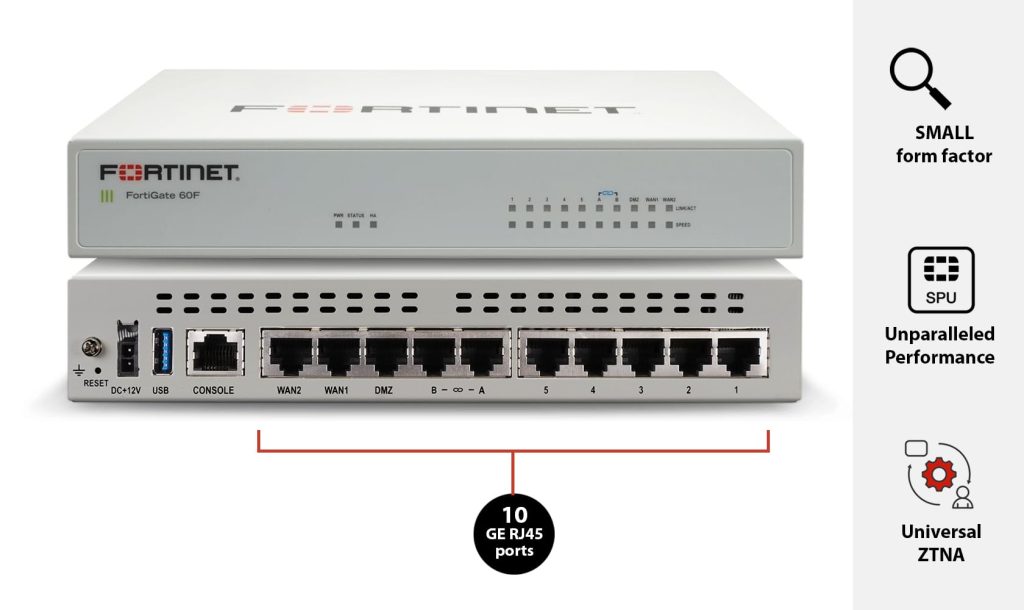
The FortiGate 60F is Fortinet’s compact, high-performance firewall aimed squarely at small and medium-sized businesses (SMBs), branch offices, and remote sites. In an era when cybersecurity threats are growing more sophisticated and networks are dispersed across cloud services and remote workers, the need for an all-in-one security appliance that’s easy to deploy and manage has never greater. This review examines the FortiGate 60F’s hardware, security features, performance, usability, and value to help you decide whether it’s the right firewall for your organization.
Hardware and Design
Physically, the FortiGate 60F is designed for small-footprint environments. It typically ships as a desktop unit with a durable metal chassis and ventilation suitable for 24/7 operation. The appliance provides a mix of gigabit Ethernet ports for WAN and LAN, often including at least one SFP slot for fiber connectivity—handy for ISPs or links that require fiber uplinks. PoE is not standard on the 60F (that’s more common in Fortinet’s switching portfolio), but the device’s compactness and port variety make it easy to slot into most small office wiring closets.
A key hardware differentiator is Fortinet’s use of the company’s proprietary Security Processing Unit (SPU) silicon. The SPU accelerates critical functions such as encryption and threat inspection, offloading work from the general-purpose CPU. For SMBs, this translates to faster throughput for VPNs, SSL inspection, and NGFW (next-generation firewall) features even when multiple services run concurrently.
Form Factor and Ports
The 60F’s small desktop form factor is well-suited to office racks and closets. Typical port configurations include multiple Gigabit RJ-45 ports and at least one SFP port for fiber uplinks. While it lacks built-in Wi‑Fi and PoE, it pairs easily with Fortinet switches and access points for a full-site solution.
SPU Acceleration
Fortinet’s SPU is a standout feature. By handling encryption and deep packet inspection tasks in hardware, the SPU helps preserve throughput when advanced security services are enabled—important for SMBs that need security without sacrificing speed.
Security Features and Services
FortiGate appliances are best known for bundling an extensive set of security services, and the 60F is no exception. Core features include:
- Next-Generation Firewall: Stateful firewalling augmented with application control, user/identity-based policies, and deep packet inspection.
- Intrusion Prevention System (IPS): Signature and anomaly-based detection to block exploits and reconnaissance.
- Antivirus and Anti-Malware: Scanning of files and traffic for known threats.
- Secure Web Gateway/URL Filtering: Controls web access and blocks malicious or non-compliant sites.
- DNS Filtering: Blocks access to risky domains before connections are made.
- SSL/TLS Inspection: Decryption and inspection of encrypted traffic to catch threats hiding in HTTPS sessions.
- Advanced Threat Protection (ATP): Sandboxing (when paired with FortiSandbox) for analyzing suspicious files and advanced malware.
- VPN: High-performance IPsec and SSL VPNs for secure site-to-site and remote-access connectivity.
- Zero Trust and NAC features: Integration with Fortinet Identity and Access systems for device/user posture checks.
Licensing Model
Fortinet uses a subscription model for many of these services (FortiGuard Labs) — antivirus, IPS, web filtering, and advanced threat protection typically require licensing. The 60F can perform basic firewall and VPN functions without subscriptions, but full real-time threat intelligence and advanced protections require FortiGuard services.
Performance
Performance is where the FortiGate 60F often shines compared to generic x86 appliances. Fortinet’s SPU acceleration yields impressive numbers for an appliance of this size: high firewall throughput, strong VPN throughput, and SSL inspection performance that remains usable under heavy encryption loads. In real-world SMB deployments—where internet links are often in the hundreds of Mbps rather than multi-gigabit—the 60F’s throughput is generally more than sufficient.
Real-World Considerations
Performance depends on enabled features. Enabling deep SSL inspection, IPS, antivirus, and content filtering simultaneously will reduce throughput relative to raw firewall forwarding numbers. The SPU helps maintain higher performance under feature load compared to non-accelerated devices, but administrators should plan capacity around expected feature usage and concurrent sessions.
Management and Usability
FortiGate offers multiple management options. For single-device deployments, the web-based GUI (FortiOS) is comprehensive and commonly used. It provides a policy tree, visualization of traffic, and wizards for common tasks (VPN setup, NAT rules, etc.). Administrators familiar with Fortinet will appreciate the depth of configuration options; newcomers may find the interface has a learning curve compared to simpler consumer routers.
Centralized Management
For multi-site or multi-device environments, Fortinet’s centralized management options (FortiManager and FortiCloud) streamline policy deployment, firmware updates, and logging. FortiAnalyzer further enhances logging, reporting, and forensic investigation capabilities. For SMBs without a dedicated security operations team, FortiCloud offers an approachable cloud-based management plane with simplified logging and analytics.
Single Pane of Glass
A practical advantage is Fortinet’s single pane of glass when using other Fortinet products: switches, access points, and FortiGate firewalls can be managed and monitored together, simplifying troubleshooting and policy consistency across wired and wireless environments.
Integration and Ecosystem
Fortinet positions the FortiGate as part of a broader security fabric. Native integrations with FortiSandbox, FortiMail, FortiClient (endpoint protection and VPN), FortiAP (wireless), and FortiSwitch allow for coordinated threat intelligence and automated responses. The Security Fabric can automatically quarantine compromised endpoints, propagate indicators of compromise, and simplify enforcement of security policies across the network.
For SMBs that want a single vendor to cover firewall, endpoint, wireless, and switching, this ecosystem reduces the complexity of integrating disparate tools. However, it does encourage investment in Fortinet’s broader product and licensing portfolio.
Licensing and Cost Considerations
The hardware cost of a FortiGate 60F is competitive for SMB-targeted enterprise-grade firewalls. The important budgeting consideration is recurring subscription costs for FortiGuard services and, if desired, centralized management and advanced threat services (FortiAnalyzer, FortiManager, FortiSandbox). For organizations with limited staff, consider professional services or an MSSP that uses Fortinet gear.
TCO Factors
When comparing total cost of ownership, factor in:
- Subscription licenses for antivirus, IPS, web filtering, and sandboxing.
- Optional management subscriptions (FortiCloud) or appliance/software (FortiManager/FortiAnalyzer).
- Support and firmware subscriptions (FortiCare).
- Training or managed services if staff are inexperienced.
Pros and Cons
Pros
- Strong performance for its class thanks to SPU acceleration.
- Rich suite of integrated security services and central management options.
- Good VPN performance for remote work and site-to-site connectivity.
- Mature ecosystem with well-integrated Fortinet products.
- Small form factor suitable for SMB offices and remote branches.
Cons
- Licensing model can add significant recurring costs for full protection.
- Learning curve for administrators new to FortiOS.
- Not ideal for users who prefer an entirely open-source stack or single flat fee for all features.
- PoE and built-in Wi-Fi not included—additional hardware purchase required for those features.
Use Cases and Recommendations
The FortiGate 60F is particularly well suited for:
- SMBs that need enterprise-grade security but have limited space and IT staff.
- Branch offices and retail locations requiring secure VPN connections to central sites.
- Organizations using multiple Fortinet products seeking simplified management and integrated security.
- Environments with moderate performance needs (up to hundreds of Mbps) and heavy use of security services like SSL inspection and IPS.
If your organization has a multi-gigabit internet link, extremely high concurrent session counts, or specialized feature requirements (built-in Wi‑Fi or PoE), consider larger FortiGate models or complementary hardware. If budget is the primary constraint, evaluate lower-cost alternatives—but remember those often lack the 60F’s integrated threat intelligence and performance under load.
Conclusion
Is the FortiGate 60F the ultimate SMB firewall? For many small and medium businesses seeking a high-performance, feature-rich, and integrated security solution, the 60F is an excellent choice. Its SPU-accelerated performance, comprehensive security services, and ecosystem benefits make it a strong contender in the SMB space. However, the total value depends on your willingness to invest in subscriptions and possibly additional Fortinet hardware for a fully integrated solution. If you prioritize strong real-time protection, VPN performance, and centralized management across multiple sites, the FortiGate 60F is likely to be one of the best options available. If your needs are extremely simple or budget-tight without tolerance for ongoing licensing costs, you may want to evaluate lower-cost alternatives or entry-level devices—keeping in mind they will offer less comprehensive protection.